
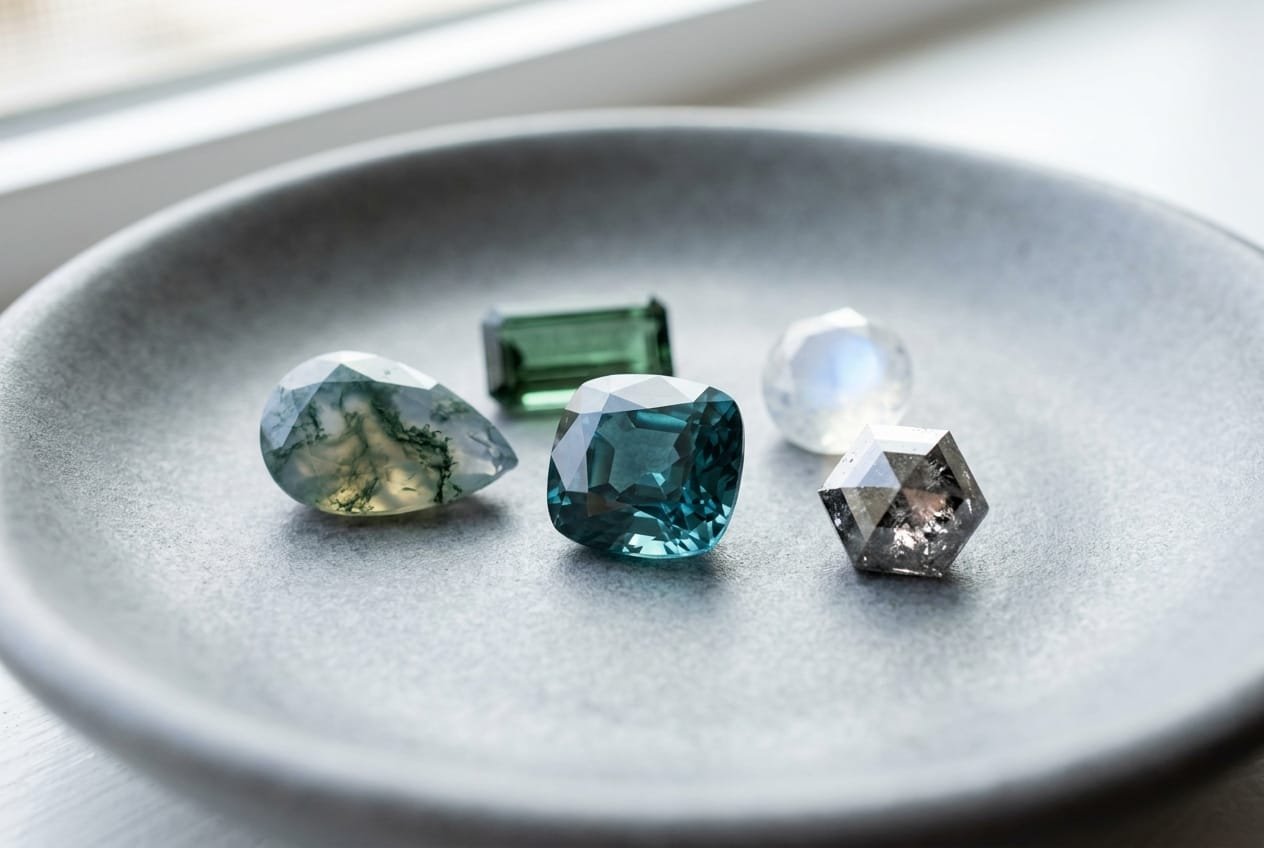
For decades, the colourless gemstone conversation had one default answer. In 2026, that’s simply no longer true. A whole field of alternatives is winning shelf space and attention, and buyers are increasingly, happily spoilt for choice.
The shift is driven partly by economics and partly by values, but also by genuine advances in what these stones can do. High-brilliance colourless gems now offer optical performance that, on the specific measures of light return and fire, can match or exceed traditional stones — while carrying a lab-grown, traceable origin. The “alternative” is no longer a compromise; often it’s an upgrade.
Engineered silicon carbide sits at the centre of this movement. Its refractive index is among the highest of any gem material, giving it intense brilliance, and its dispersion is high enough to throw distinctly livelier fire than most colourless stones. Specialist brands now cut it as a fine gemstone in its own right: the silicon carbide cut by Zeverra, for instance, is grown and faceted specifically to maximise those optical qualities, then supplied to jewellers who set it. It’s presented not as a stand-in for anything but as a distinct stone with its own character.
Colour is having a parallel moment. Lab-grown sapphires and rubies are appearing in serious fine settings, offering saturated colour with a clean origin. Once-overlooked natural stones like spinel and tourmaline are being rediscovered by contemporary designers drawn to their colour range and value. And created coloured stones are widening the palette further, making shades that were once rare or costly newly accessible.
What’s driving buyers toward these alternatives is a combination of factors. Value is one: many deliver the look people want at a fraction of the traditional cost. Origin is another: created stones answer provenance questions that mined ones sometimes can’t. And performance is a third — on brilliance, fire and durability, several of these stones genuinely compete with or beat the old default.
For anyone shopping, the practical takeaway is that “alternative” no longer implies “lesser.” The smart approach is to judge each stone on its own merits — cut, brilliance, durability, origin — rather than by whether it’s the traditional choice. Tilt a stone in the light and watch how it performs. Ask how it was made. Consider how hard it needs to be for the way it’ll be worn.
The broadening of the field is, ultimately, a healthier market for everyone shopping it. More options mean more competition on quality and price, more transparency about origin, and more freedom to choose a stone that genuinely suits your taste, budget and values rather than defaulting to convention. The single right answer has become a genuine choice — and that’s a change worth celebrating.
