
Entering mathematical competitions can feel unfamiliar when students are used to straightforward textbook exercises. As they begin exploring more challenging problems, resources such as Maths Olympiad books for beginner learners can provide a helpful bridge between familiar classroom concepts and competition-style questions. These books gradually introduce unusual question formats, logical reasoning, and problem-solving challenges, allowing children to build confidence and develop the patience needed to explore unfamiliar mathematical situations.
Table of Contents
|
Starting With the Right Expectations
A beginner entering mathematical competitions may assume that success depends mainly on knowing more formulas or completing calculations quickly. In reality, competition questions can ask students to interpret information, recognise relationships, test possibilities, and select an appropriate strategy.
This difference can make the first experience challenging. A student may understand school mathematics well but still need time to adjust to questions where the method is not immediately obvious.
Beginner-oriented practice can help bridge this gap. Instead of treating competition preparation as a race toward difficult questions, students can first develop familiarity with the style of mathematical thinking required.
What Beginners Need to Develop
A useful starting point involves building several abilities together:
- Reading questions carefully
- Identifying relevant information
- Recognising mathematical relationships
- Trying more than one possibility
- Explaining how an answer was reached
- Staying engaged when the first attempt does not work
These abilities provide a foundation for more advanced competition practice later.
Becoming Familiar With Competition-Style Questions
One of the first challenges beginners face is that competition questions may look different from ordinary classroom exercises. The wording can be less direct, and a problem may combine several mathematical ideas.
For example, instead of asking students to calculate a simple percentage, a competition problem may present a situation in which percentages must be inferred from relationships between quantities.
Exposure to these formats helps reduce unfamiliarity. As students encounter different structures, they gradually become more comfortable asking what the problem is really testing.
Recognising Common Question Structures
Beginners may encounter questions involving:
- Number patterns
- Logical arrangements
- Geometry and spatial relationships
- Counting possibilities
- Fractions and ratios
- Measurement
- Mathematical puzzles
- Sequences and relationships
The objective is not to memorise a list of question types. It is to help students recognise that different problems may require different ways of thinking.
Learning How to Read a Challenging Problem
Reading comprehension plays an important role in mathematical problem solving. A student may know the mathematics needed to solve a question but still struggle because the information has not been interpreted correctly.
Beginners can therefore benefit from learning to slow down before calculating. They can identify what is known, what needs to be discovered, and what conditions the answer must satisfy.
A Simple Reading Routine
Students can begin with four questions:
What do I know?
Identify the information explicitly provided.
What do I need to find?
Determine the exact requirement of the question.
What conditions matter?
Look for restrictions, comparisons, or relationships.
What could I try first?
Choose a reasonable starting point rather than searching immediately for a perfect method.
This routine can make unfamiliar questions feel more approachable without turning problem solving into a rigid formula.
Building Confidence Through Manageable Challenges
Beginners often lose confidence when every practice session contains problems that seem far beyond their current ability. Challenge is useful, but it needs to be introduced at a suitable pace.
A gradual sequence allows students to experience early success before encountering more demanding problems. Once they understand the structure of a particular type of question, they can begin exploring variations that require additional reasoning.
This progression can create a healthier relationship with difficult mathematics. Students learn that challenging questions are something they can investigate rather than something they are expected to solve instantly.
The Beginner Challenge Curve
A useful progression can look like this:
Familiar concept → New presentation → Guided challenge → Independent attempt → Multi-step problem → Competition-style challenge
Each stage introduces something new without making the entire learning experience unfamiliar at once.
Discovering Mathematical Ideas Through Puzzles
Puzzles can be an effective bridge between ordinary mathematics and competition preparation. They encourage students to look for relationships, test ideas, and think creatively without always feeling like formal examination practice.
A puzzle might involve arranging numbers, identifying a hidden relationship, finding an efficient route, or determining which possibilities satisfy several conditions.
These activities can strengthen curiosity because the learner is solving a problem to discover something rather than simply completing an assigned calculation.
Why Puzzles Can Help Beginners
Puzzle-based activities can encourage students to:
- Explore several possibilities
- Notice unusual relationships
- Make predictions
- Test assumptions
- Explain their reasoning
- Enjoy the process of discovery
This type of experience can make the transition into more formal Olympiad preparation less intimidating.
Learning to Work Without an Immediate Formula
One major adjustment for beginners is learning that not every problem comes with an obvious formula.
In school exercises, the appearance of a particular question may suggest the procedure to use. Competition problems often require students to decide what mathematical tools are relevant.
This encourages a shift from “Which formula should I use?” to “What relationship can help me solve this?”
Exploring Before Calculating
A student might first:
- Draw a diagram
- List possible cases
- Create a simple example
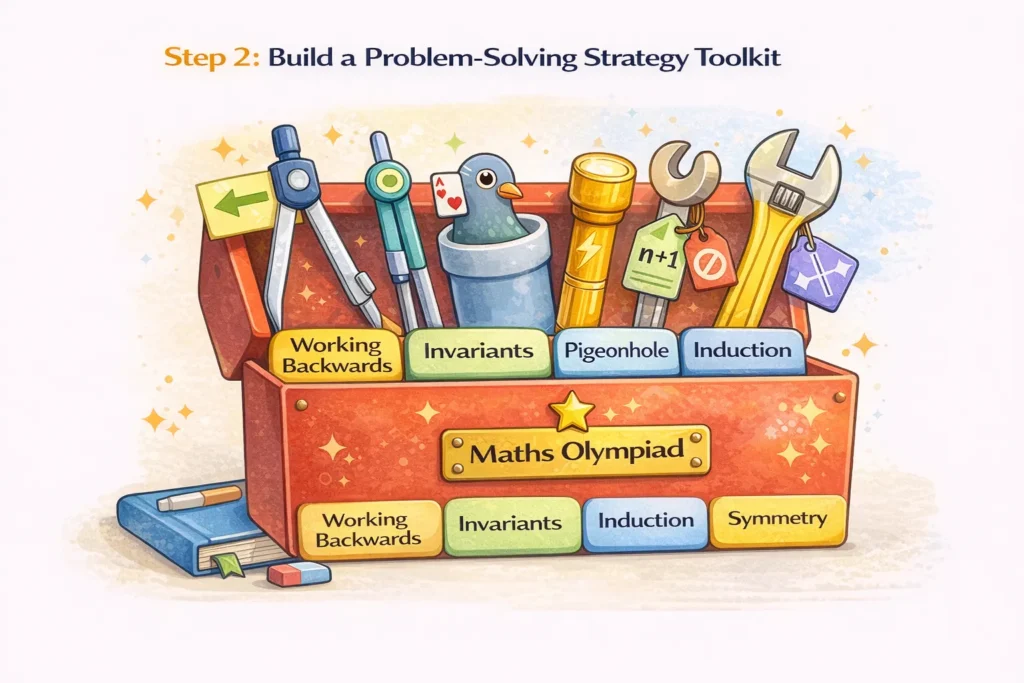
- Work backwards
- Organise information in a table
- Look for a numerical relationship
- Eliminate impossible options
These approaches can reveal the structure of a problem before formal calculations begin.
Developing Competition Awareness Step by Step
Competition readiness involves more than solving difficult questions. Students also need to become familiar with the experience of working under specific conditions.
A beginner can gradually learn how to manage attention, decide when to continue with a method, and recognise when another approach may be more productive.
The aim is not to pressure young learners into racing through questions. Instead, they can develop awareness of how to approach a set of unfamiliar problems calmly and systematically.
Important Competition Habits
Beginners can gradually learn to:
- Read all relevant information before starting.
- Avoid spending too long on one unproductive approach.
- Mark difficult questions for another attempt later.
- Check whether answers satisfy the conditions.
- Compare different methods after completing a problem set.
These habits can become increasingly useful as students progress to more demanding competitions.
Turning Difficult Questions Into Learning Opportunities
A beginner will not solve every competition-style problem correctly. That is a normal part of learning advanced problem solving.
An incorrect answer can reveal an overlooked condition, an unsupported assumption, or a misunderstanding of the relationship between different pieces of information.
The important step is to examine the reasoning rather than simply replacing the wrong answer with the correct one.
A Better Way to Review a Difficult Problem
After an unsuccessful attempt, students can ask:
- Where did my reasoning change direction?
- Which information did I overlook?
- Was my assumption supported by the problem?
- Could I represent the situation differently?
- What would I try if I encountered a similar question?
This type of reflection turns a difficult question into a reusable learning experience.
Understanding How Different Problem Types Require Different Thinking
Competition mathematics becomes more interesting when students realise that not every problem should be attacked in the same way.
A counting question may benefit from systematic listing, while a geometry problem may become clearer through a diagram. A sequence may require pattern investigation, whereas a logic problem may require elimination.
The ability to select an approach is therefore an important part of mathematical maturity.
Beginner Practice Map
| Problem Situation | Possible Starting Point | Thinking Skill |
| Number sequence | Compare relationships between terms | Pattern recognition |
| Arrangement puzzle | List or organise possibilities | Logical reasoning |
| Geometry problem | Draw and label the figure | Visual reasoning |
| Counting problem | Start with smaller cases | Systematic thinking |
| Ratio situation | Identify the relationship between quantities | Relational thinking |
| Logic question | Eliminate impossible choices | Deduction |
The table is not meant to create fixed rules. A single problem may have several valid approaches, and learning to choose among them is itself a useful skill.
Creating a Beginner-Friendly Competition Journey
Competition preparation becomes more sustainable when students have a clear sense of progression. Instead of moving directly from school exercises to the hardest available problems, learners can experience several intermediate stages.
A beginner might start with short reasoning questions, move to multi-step challenges, explore unfamiliar applications, and eventually attempt timed competition-style sets.
A Four-Stage Beginner Journey
Stage 1: Explore
Students become comfortable with puzzles, patterns, and unusual mathematical situations.
Stage 2: Apply
They begin using familiar concepts in less familiar contexts.
Stage 3: Reason
They solve multi-step problems where the method is not immediately given.
Stage 4: Simulate
They practise sets that resemble competition conditions and learn to manage their approach independently.
This structure gives learners time to develop confidence while gradually increasing the complexity of the problems they encounter.
Where an Assessment Book Can Support the Journey
Competition preparation works best when students have strong foundations in the mathematics they are expected to use. An assessment book can support this foundation by providing opportunities to check understanding of curriculum-related concepts.
For example, if a learner is preparing for challenging number problems but has uncertainty around fractions or basic arithmetic relationships, targeted assessment can help reveal that gap.
The two resources can therefore have complementary roles. Assessment-focused practice can help identify areas that need reinforcement, while Olympiad-oriented questions can encourage students to apply mathematical knowledge in unfamiliar situations.
Helping Beginners Become More Independent
The long-term goal of beginner preparation should be independence. Students should gradually become capable of deciding how to approach a problem without waiting for someone to identify the method for them.
Adults can encourage this by offering prompts rather than complete solutions. Questions such as “What do you notice?” or “Could you try a smaller example?” can help children continue thinking.
Moving From Support to Independence
At first, a learner may need:
- A question prompt
- A diagram suggestion
- Help identifying the known information
- An example of how to organise possibilities
Later, the same learner may independently decide to draw a diagram, create a table, test a smaller case, or work backwards.
That transition is a strong indication that competition preparation is developing mathematical independence rather than simply increasing the number of questions completed.
Making Competition Preparation Enjoyable
Beginners are more likely to remain engaged when preparation includes variety. A session does not always need to consist of a long series of difficult questions.
Students can alternate between puzzles, reasoning problems, pattern challenges, discussion of different solutions, and short competition-style sets.
Parents and educators can also encourage students to explain interesting discoveries. Discussing an unexpected solution can make mathematical learning feel more like exploration than examination preparation.
The emphasis should remain on curiosity, persistence, and thoughtful reasoning. Competition results can provide useful feedback, but they do not need to be the only measure of progress.
Final Takeaway
Beginning competition preparation is easier when students are introduced to challenging mathematics gradually. Maths Olympiad books for beginner learners can help bridge the gap between familiar school exercises and competition-style problems by providing opportunities to explore patterns, puzzles, logical relationships, and unfamiliar applications.
The most valuable preparation is not simply completing a large number of questions. It is learning how to read carefully, choose an approach, experiment with possibilities, reconsider unsuccessful attempts, and explain mathematical reasoning.
For beginners preparing for mathematics competitions, regular practice with age-appropriate problems can help strengthen skills such as numerical reasoning, pattern recognition, and logical problem-solving. Resources from Singapore Asia Publishers can support this preparation by giving students structured opportunities to practise different question types, review their mistakes, and apply mathematical concepts to unfamiliar problems. With consistent use, such materials can help learners improve accuracy, build problem-solving confidence, and become better prepared for the demands of Olympiad-style mathematics.
Frequently Asked Questions
1. What are Maths Olympiad books for beginners?
Maths Olympiad books for beginners introduce students to competition-style mathematical thinking at an accessible level. They typically include puzzles, reasoning questions, patterns, and problems that require students to apply familiar concepts in unfamiliar ways.
2. Can beginners use Maths Olympiad books without competition experience?
Yes. Beginner-focused resources are specifically useful for introducing students to unfamiliar question formats. They can help learners gradually understand how competition mathematics differs from routine school exercises.
3. How often should beginners practise Olympiad mathematics?
The ideal frequency depends on the student’s age, existing mathematical foundation, and other learning commitments. Consistent, manageable practice is generally more useful than occasional sessions containing a very large number of difficult questions.
4. Do Maths Olympiad books require advanced mathematical formulas?
Not necessarily. Many beginner competition problems rely on fundamental concepts but present them in ways that require reasoning, observation, or creative problem solving rather than advanced formulas.
5. How can parents support a beginner preparing for a maths competition?
Parents can encourage children to explain their thinking, ask guiding questions, and try different approaches before giving a solution. Creating a positive environment around challenging problems can also help children develop persistence.
6. Should an assessment book be used alongside Olympiad preparation?
It can be useful because the two resources serve different purposes. An assessment book can help check curriculum understanding, while Olympiad materials can provide additional challenges involving reasoning and unfamiliar problem structures.
7. What should a beginner do when a Maths Olympiad problem seems impossible?
The student can start by identifying the known information, simplifying the problem, drawing a diagram, testing a smaller example, or listing possible cases. Breaking the problem into smaller parts can often reveal a useful starting point.
