
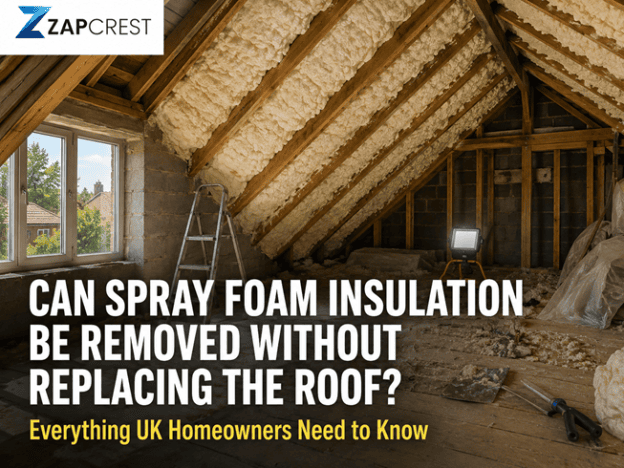
Spray foam insulation was fitted in thousands of UK lofts as a way to improve thermal performance, but for some homeowners it becomes a problem later – particularly when the roof needs inspecting, repairing or preparing for a sale. The good news is that discovering spray foam does not automatically mean the whole roof has to be replaced.
Why homeowners assume a new roof is inevitable
The confusion usually starts because spray foam is bonded to rafters, underlay and sometimes the underside of tiles. Once cured, it is not a loose material that can simply be lifted out. It can also hide parts of the timber structure from view. RICS guidance on spray foam insulation notes that some installations can make roof defects harder to identify because the structure cannot be fully seen or inspected.
That does not mean every covered rafter is damaged. It means the condition of the roof needs to be established before anyone decides whether local repairs, removal or more extensive roofing work is justified.
Can spray foam be removed from inside the loft?
In many properties, yes. Professional spray foam removal is normally approached from inside the roof space. The foam is progressively cut back and separated from the rafters so the underlying timber can be exposed and assessed.
This is very different from automatically stripping off tiles and rebuilding the roof from outside. If the roof covering is still serviceable and the timbers are sound, internal removal may allow the existing roof to remain in place. Where defects are uncovered, the work can then be targeted at the sections that actually need attention.
What decides whether the roof can stay?
- The condition of the rafters once the foam is exposed.
- Whether there is damp, mould, softness or decay in the timber.
- What the foam has been sprayed onto – for example, breathable membrane, older felt or directly onto tiles.
- Whether the roof already had leaks or defects before the foam was installed.
- The type and density of foam and how strongly it has bonded to the surface.
- Whether ventilation can be restored after the foam is removed.
A responsible contractor should therefore inspect before quoting for major structural work. A recommendation to replace an entire roof purely because foam is present should be supported by evidence of the roof’s actual condition.
Open-cell and closed-cell foam behave differently
Open-cell foam is generally softer and more flexible, which can make it easier to cut and peel away. Closed-cell foam is denser and may adhere more aggressively. That can make removal slower and more labour-intensive, but it still does not prove that a full re-roof is required.
What matters is what is found underneath. The removal process creates the opportunity to inspect areas that may have been obscured for years.
Why careful removal matters
Speed is not the only measure of a good job. Aggressive removal can gouge timber, damage membranes or make the finished roof harder to assess. The aim should be to expose the roof structure while preserving sound material wherever possible.
Homeowners should also keep a record of the work. Before-and-after photographs, details of any repairs and an independent inspection can be valuable if a surveyor, buyer or lender later asks what was done.
How much does removal cost compared with a new roof?
Prices vary with roof area, foam type, access and the condition revealed during the job. A useful starting point is a current spray foam removal cost guide, but an on-site survey is more meaningful than a headline price because two lofts of the same size can require very different amounts of work.
If the roof itself is fundamentally sound, removal and localised repairs can be substantially less disruptive than a complete replacement. If significant decay or failed roofing materials are found, more extensive work may be the sensible long-term option.
The sensible order of decisions
For most homeowners, the practical sequence is simple: inspect the roof, understand how the foam was installed, remove it where necessary, expose the structure and then decide what repairs are genuinely required. That avoids treating spray foam as proof that the roof has failed.
Spray foam can complicate a roof, but it does not automatically condemn it. The difference between a targeted removal and an unnecessary re-roof can be thousands of pounds, which is why evidence should come before assumptions.
