
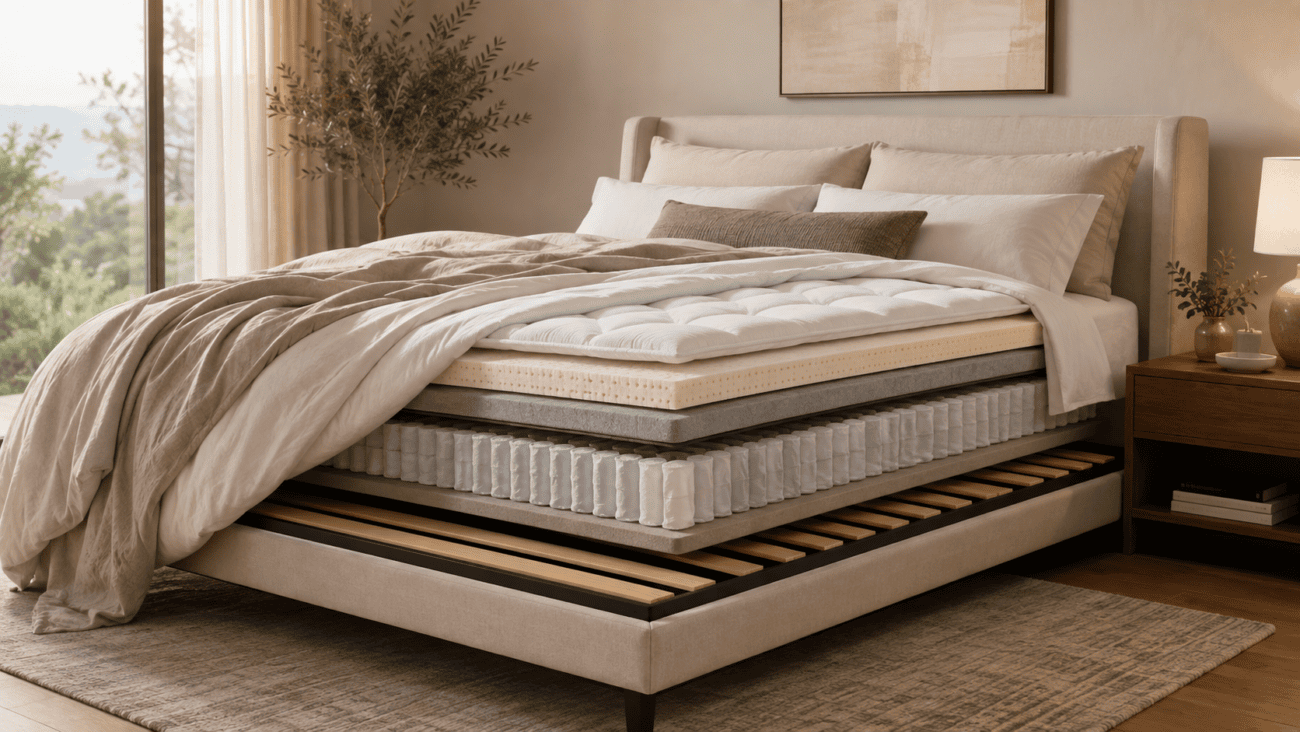
You may have spent $2,000 on your mattress, but you can undermine all that money by buying a bed frame with slats that are five inches apart.
Bedroom tips generally begin from the top, with your duvet covers and throw pillows. That’s the wrong end. Whether you’re browsing or working with the frame you already own, build from the floor up. Support first, textiles last.
Start at the frame, because everything above it inherits the flaws
A mattress can only be as flat as the thing holding it.
Slats spaced more than about three inches apart let foam and hybrid mattresses sag into the gaps. You get a subtle washboard effect you’ll never see and will absolutely feel by month four. Most manufacturers void warranties over this, which tells you they’ve seen it plenty.
Queen- and king-sized frames also need a center support leg that reaches the floor. Not a crossbeam floating between the rails. An actual leg.
Test yours tonight. Sit on the edge of the bed and listen. Creaking means the joints have loosened, and loose joints mean uneven support.
If you’re shopping the range at walkermattress.com or anywhere else, lie down in your real sleeping position for a solid ten minutes. Sitting on the edge tells you nothing.
The mattress has exactly one job
Keep your spine roughly neutral, in whatever position you actually sleep in.
That’s it. Everything else is marketing. A systematic review in Sleep Health examined controlled trials on mattress design, spinal alignment, and pain outcomes, and the consistent thread is that medium-firm surfaces tend to perform well for most sleepers. Not universally. But it’s the sensible default if you don’t know where to start.
Your sleeping position drives the rest. Side sleepers need enough give at the shoulder and hip that those points sink in and the waist stays supported. Back and stomach sleepers need firmer because too much sink drops the hips and arches the lower back all night.
Layering is a heat problem when wearing a decorative costume
Here’s the part the decor blogs skip. Layers aren’t only about looks. They’re your thermostat.
Researchers testing duvets with thermal resistance from 3.81 to 8.93 clo found that heavier insulation widened the comfortable ambient temperature range considerably. A warmer duvet doesn’t just make you warmer. It makes the room temperature matter less.
And that’s fortunate, since Harvard Health states that the optimal bedroom temperature falls between 65 and 68 degrees, while the NHLBI recommends maintaining a cool, dark, and quiet bedroom in its guidelines on healthy sleeping practices. A cool room combined with temperature-adjustable layers wins over a warm room combined with a thick blanket every single time.
The importance of texture, in order of how it touches you
Think from skin outwards
Percale cotton is crisp and breathable, and it is used by hotels because of its ability to withstand industrial laundering. Sateen is smooth and warm, which is an advantage in January and a disadvantage in July. Linen looks rumpled by design, wicks moisture better than either, and softens for years instead of pilling.
Then vary the surfaces going up. Something smooth against you, something with loft in the middle, something with visible weave on top. A waffle blanket over percale sheets under a linen coverlet reads as considered without you doing anything clever.
Contrast is what makes it look designed. Three matching pieces from the same set look like a hotel room nobody has moved into yet.
A five-layer build that works year-round
- Fitted sheet, percale for summer, sateen for winter
- Flat sheet, which most people skip and shouldn’t, since it’s the layer you strip when you overheat at 3 a.m.
- A light blanket or quilt, folded to the foot of the bed when unused
- Duvet, weight chosen for your coldest season, not your average one
- A textured throw across the bottom third for the visual break
The flat sheet and the folded blanket are the adjustable parts. That’s the whole system.
Fix it in this order
Frame first. Mattress, second. Pillow third, matched to how you sleep. Sheets and top layers last.
Doing it in reverse is how people end up with beautiful linen bedding on a sagging bed and no idea why their shoulder hurts. If you’re pricing out a full replacement at walkermattress.com or comparing options elsewhere, spend the budget bottom-up rather than top-down.
