
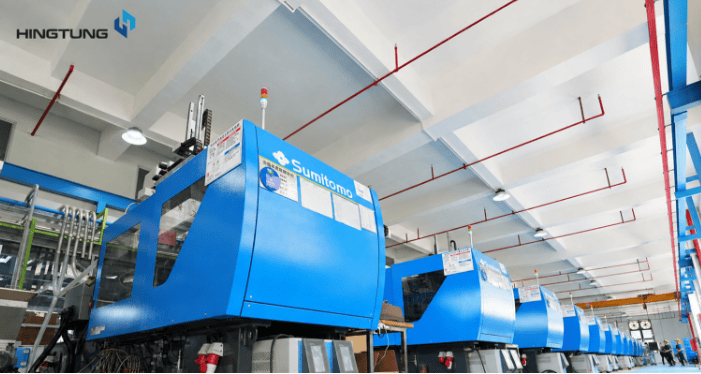
An injection-molded part can leave the press with the right shape and dimensions but still be far from ready for delivery. It may need machining, threaded inserts, printing, welding, assembly, testing, or protective packaging.
Problems often appear when these requirements are added after tooling or sampling. Coatings can reduce assembly clearance, inserts may crack an unsupported boss, and late packaging decisions can expose cosmetic parts to damage. Secondary operations should be planned around the final product rather than added after molding begins.
Define the Required Delivery Condition
Start by confirming exactly what the manufacturer is expected to ship. A bare molded component has a different production scope from a painted housing with inserts, labels, hardware, testing, and protective packaging.
The RFQ should state whether the output is an individual molded part, a finished component, a subassembly, or a completed assembly. Assembly drawings and a bill of materials are useful when the project includes electronics, metal parts, seals, fasteners, labels, or customer-supplied components.
Confirm Supply Responsibilities
Identify which items will be manufactured, purchased, or supplied by the customer. The same applies to fixtures, gauges, labels, and packaging materials. Supply responsibility, approved sources, quantities, and timing should be agreed before production so assembly is not delayed by missing parts.
Include Secondary Operations in the Quotation
Secondary operations can add fixtures, labor, inspection, handling, and process-development costs. A molding quotation that does not define these items may look competitive while leaving much of the real production scope unresolved.
The quotation should confirm:
- Required operations and processing areas
- Fixtures, masks, gauges, and setup costs
- Sample quantities and approval rounds
- Cleaning, surface preparation, and masking
- Inspection methods and sampling frequency
- Expected process loss and acceptable rework
- Packaging and transportation protection
- Responsibility for rejected or damaged parts
- Lead time for each operation
Approval also needs a clear endpoint. An unpainted molded part is not the same deliverable as the same part after coating, insert installation, welding, and assembly. Tooling, processing, inspection, assembly, and packaging costs should be separated where practical.
When molding, machining, finishing, and assembly are handled separately, problems often appear between processes. A machining supplier may need a locating surface that was not considered during mold design, while coating or insert installation may change clearances or local strength. Projects with these dependencies need downstream requirements reviewed before tooling is finalized. The HingTung injection molding company can coordinate mold manufacturing, molding, CNC machining, secondary processing, assembly, and inspection around the same part requirements, allowing machining references, insert areas, cosmetic surfaces, and inspection points to be considered earlier.
Group Secondary Operations by Purpose
Secondary operations are easier to manage when grouped by what they must achieve. Some improve dimensional stability, while others add features, create a finished appearance, or prepare parts for assembly.
Material Conditioning and Dimensional Stability
Some materials or part geometries may require conditioning, controlled fixturing, or stabilization before final measurement. Moisture-sensitive plastics can change dimensions after molding, while large or uneven parts may continue to relax as they cool.
The inspection plan should state when dimensions are measured and under what conditions. A part checked directly after molding may not give the same result after storage, conditioning, machining, or assembly.
Machining and Feature Completion
Drilling, tapping, trimming, reaming, and local CNC machining can add features after molding. This can suit low-volume details, dimensions that may change during development, or features that would otherwise require complex mold actions.
Post-mold machining also adds fixtures, burr control, cleaning, and another inspection stage. Its unit cost should be compared with the cost and reliability of molding the same feature directly.
Inserts, Joining, and Assembly
Threaded inserts, pins, bushings, terminals, and fasteners may be installed by heat, ultrasound, pressing, or mechanical fastening. The surrounding plastic must support the installation force, pull-out strength, and torque without cracking.
The joining method should match product use. Screws and serviceable clips may suit products that need repair, while ultrasonic welding or heat staking can suit permanent assemblies. Sealing, alignment, appearance, and maintenance should be considered before tooling is finalized.
The challenge becomes greater when the molded component is only one part of a larger product. A housing may also need PCB mounting points, inserts, buttons, labels, metal brackets, cosmetic surfaces, and controlled assembly gaps. These interfaces need to be reviewed around the finished assembly rather than managed independently. HingTung consumer electronics manufacturing can coordinate molded parts with machining, secondary processing, assembly, and inspection so mounting features, mating components, appearance requirements, and final fit are considered within the same production plan.

Decorating and Marking
Painting, pad printing, screen printing, laser marking, and labels can add color, branding, instructions, or traceability. Selection depends on the resin, surface texture, marking area, wear exposure, chemicals, outdoor conditions, and production quantity.
Drawings should identify cosmetic surfaces, color references, acceptable process marks, and areas that must remain free from paint or ink. A controlled color sample is clearer than a description such as “dark gray.”
Plan the Process Sequence
The order of operations can affect dimensions, appearance, cleanliness, joint strength, and rework. Painting before insert installation may require masking. Machining after decoration may damage the finish, while welding after printing can expose marked areas to heat.
A simple process flow should show when parts are conditioned, machined, cleaned, decorated, assembled, inspected, and packed. It should also identify where measurements and approvals are required.
| Process step | What to confirm |
| Material conditioning | Whether treatment changes dimensions or part shape |
| Machining | Inspection stage, burr removal, and cleanliness |
| Insert installation | Position, depth, torque, and pull-out requirements |
| Decoration | Surface preparation, masking, and approved color |
| Joining | Heat, vibration, pressure, and joint-strength limits |
| Final assembly | Fit, gap, alignment, movement, and function |
| Packaging | Protection from scratches, mixing, and deformation |

Protect Parts Between Operations
A cosmetic housing may pass inspection after painting but still be scratched during storage or assembly. Trays, gloves, separators, protective film, and handling rules should match the finish. High-gloss, transparent, painted, and textured parts may need different protection.
Decide Where Each Operation Should Run
Simple and repeatable operations can sometimes be completed at or near the molding press. Automated removal, gate trimming, basic presence checks, or stable insert loading may fit the molding cycle and reduce handling.
Complex machining, decoration, multi-part assembly, and functional testing usually need separate workstations. Off-line work offers more flexibility for fixtures, labor, inspection, and changing schedules. The choice should consider quantity, cycle time, operation length, automation investment, and the effect of a secondary-operation problem on the molding cell.
Inspect the Finished Part or Assembly
A molded component can pass dimensional inspection and still fail after later processing. Machining may introduce burrs or contamination. Insert installation can distort a boss. Coating can reduce assembly clearance, while welding may affect alignment.
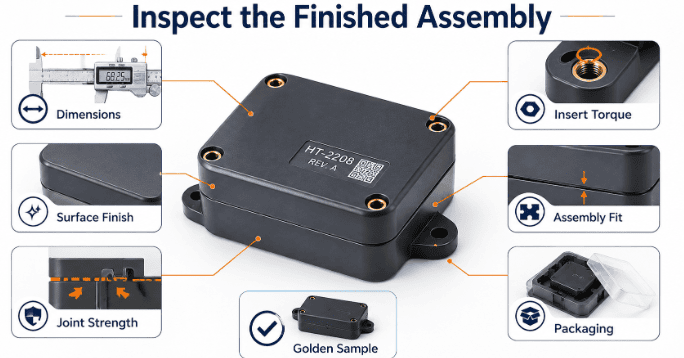
Final inspection should reflect the condition in which the customer receives the product. Depending on the project, this may include dimensions, insert torque, joint strength, color, print adhesion, assembly gaps, sealing, movement, labels, and packaging.
Establish a Golden Sample
For repeat production, the approved reference should represent the completed part rather than only the original molded component. A golden sample can show the accepted finish, color, markings, inserts, assembly fit, cosmetic limits, and packaging. Inspection drawings and test methods should support it across future batches.
Keep Revisions and Handoffs Under Control
When several processes are involved, even a small engineering change can affect the mold, fixtures, finishing, assembly, and inspection. Changing a boss may require a new insert fixture, while increased coating thickness may reduce assembly clearance. This is why secondary-operation projects need one controlled revision path. HingTung can coordinate mold changes, molded-part revisions, downstream processing requirements, assembly information, and inspection criteria within the same project workflow, reducing the risk of different stages working from outdated drawings or approval samples.
Conclusion
Secondary operations should be planned around the completed part, not added after molding begins. A clear delivery condition, detailed quotation, practical process sequence, and final-condition inspection can reduce rework and make repeat production easier to control.
HingTung supports projects where molded components must continue through machining, finishing, inserts, assembly, or inspection before delivery. Share the available 3D files and drawings, resin, quantity, critical tolerances, surface requirements, assembly details, and target schedule so the engineering team can review how these requirements interact and define the production route before tooling and secondary processes are finalized.
