
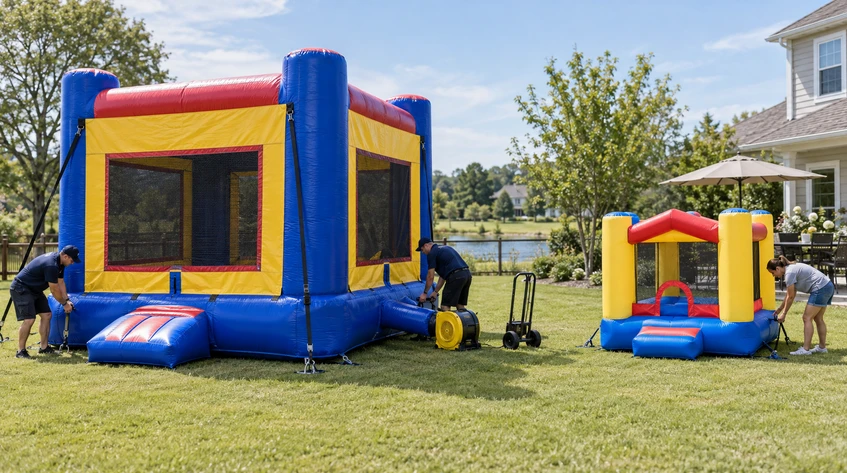
Residential and commercial bounce houses can look similar in photographs, but they are designed for different types of use. A residential model may be suitable for occasional family entertainment, while a commercial unit must withstand frequent transportation, setup, cleaning, and operation.
For party rental businesses, the choice should not be based on appearance or purchase price alone. Construction, capacity, transportation, maintenance, documentation, and total operating costs all affect whether an inflatable is suitable for repeated rentals.
Table of Contents
ToggleWhat Is a Residential Bounce House?
Residential bounce houses are primarily designed for occasional private use. Families may set them up for birthdays, weekend activities, or small gatherings at home.
These models are usually:
- Smaller and lighter
- Easier to transport and store
- Faster to set up
- Designed for fewer users
- More affordable to purchase
- Intended for occasional rather than frequent use
These characteristics make residential inflatables convenient for homeowners. However, a product designed for family use should not automatically be used in a commercial rental operation.
Buyers should always check the manufacturer’s stated purpose, user limits, operating instructions, and warranty conditions.
What Is a Commercial Bounce House?
Commercial bounce houses are intended for rental companies, event operators, entertainment venues, and other businesses that expect to use their equipment repeatedly.
Specifications vary between manufacturers and models, but commercial units generally place greater emphasis on:
- Heavier-duty materials
- Reinforced high-wear areas
- Stronger anchor points
- Frequent setup and removal
- Repairability
- Larger user capacity
- Detailed operating information
The word “commercial” alone does not prove that a product meets every local requirement. Buyers still need to examine the exact model, its supporting documents, and its intended operating conditions.
Construction and Materials
One of the clearest differences is construction. Residential models often balance affordability, low weight, and easy handling. Commercial units must account for the additional stress created by frequent transportation and operation.
Rental operators should ask suppliers about:
- Main fabric or PVC material
- Material thickness and weight
- Stitching methods
- Entry-step reinforcement
- Climbing and sliding surfaces
- Wall connections
- Inflation tubes
- Anchor-point construction
- Deflation openings
Material thickness is important, but it is not the only measure of quality. Design, stitching, reinforcement, and workmanship also influence how a product performs over time.
Buyers should request written specifications and detailed photographs instead of relying entirely on rendered product images.
Frequency of Use
A family may install a residential bounce house several times a year. A rental company might use the same inflatable several times in one week.
Every booking can involve:
- Removing the unit from storage
- Loading it into a vehicle
- Transporting it to the venue
- Unrolling and inflating it
- Operating it for several hours
- Cleaning and inspecting it
- Deflating and packing it
- Returning it to storage
This repeated process places stress on seams, anchor points, entrances, climbing lanes, slide surfaces, and inflation tubes.
Equipment selected for a rental fleet should therefore be evaluated according to its expected workload, rather than the number of times a homeowner might use it.
Size and User Capacity
Residential bounce houses are generally compact enough for home storage and backyard use. Commercial inflatables are available in a wider range of sizes and configurations, including traditional bounce houses, combination units, slides, obstacle courses, and interactive games.
A larger inflatable may attract more attention and support a higher rental price. It can also require more space, labor, power, and transportation capacity.
Before ordering, rental companies should confirm:
- Inflated dimensions
- Recommended operating area
- User height or age restrictions
- Maximum number of users
- Maximum combined weight
- Entrance and exit layout
- Required clearance
Capacity should always be based on the manufacturer’s instructions, not on how many children appear to fit inside the unit.
Anchoring and Blower Requirements
All inflatables must be installed using the anchoring or ballast method specified for the product. Commercial equipment may have more anchor points and require larger blowers than smaller residential units.
Rental operators should obtain an anchor-point diagram and confirm:
- The number and location of anchor points
- Approved stake or ballast requirements
- Blower quantity and capacity
- Electrical requirements
- Location of inflation tubes
- Applicable operating limits
The inflatable’s listed dimensions do not represent the complete area needed at an event. Additional room is required for blowers, anchoring, electrical cables, attendants, and safe entry and exit areas.
Transportation, Setup, and Storage
Residential bounce houses are often designed to fit inside a family vehicle and may be manageable for one adult. Commercial units can be considerably heavier.
Depending on the model, a rental company may need:
- A van or trailer
- A hand truck or inflatable dolly
- Two or more setup workers
- Additional drying equipment
- More warehouse space
- A suitable cleaning area
Packed dimensions and weight should be confirmed before purchase. A popular inflatable will not be profitable if the business cannot transport or install it efficiently.
Wet equipment requires particular attention. Water slides and combination units can become heavier after use and must be dried properly before long-term storage.
Cleaning, Maintenance, and Repairs
Rental equipment is regularly exposed to grass, dirt, food, moisture, and repeated folding. It must be inspected and cleaned between bookings.
Commercial buyers should consider whether the product:
- Can be inspected easily
- Has accessible cleaning areas
- Includes repair materials
- Can be repaired locally
- Has replacement components available
- Comes with maintenance guidance
A lower-priced unit can become expensive if it requires frequent repairs or remains unavailable during busy periods. Maintenance records can also help operators track wear and identify recurring problems before they become more serious.
Documentation and Local Requirements
A rental business needs accurate operating information for each inflatable. Before ordering, buyers should ask what documentation is supplied with the exact model.
Useful documents may include:
- Operating instructions
- Installation guidance
- Anchoring information
- Blower specifications
- User limits
- Inspection recommendations
- Cleaning and maintenance guidance
- Product identification details
- Warranty terms
Requirements can vary by state, city, venue, insurer, and event type. Rental operators should independently confirm which standards, inspections, permits, and insurance conditions apply in their service area.
A general claim on a supplier’s website should not replace model-specific documentation or guidance from the appropriate local authority.
Initial Price Versus Total Cost
Residential inflatables normally have a lower purchase price, which can be attractive to a new business. However, rental operators should calculate the complete cost of owning and operating the equipment.
This may include:
- Product price
- Freight and delivery
- Taxes and import fees
- Blowers and accessories
- Stakes or ballast
- Transportation equipment
- Setup labor
- Cleaning and repairs
- Insurance
- Storage
A commercial inflatable may require a larger initial investment but be more appropriate for frequent rental use. An expensive unit is not automatically a good investment either. It still needs sufficient local demand and a practical rental price.
The best value comes from equipment that can be operated reliably and rented frequently enough to recover its complete cost.
Which Type Is Better for a Rental Business?
A residential bounce house may be appropriate for occasional private entertainment when portability and a lower price are the main priorities. It should not be placed in a rental fleet unless the manufacturer specifically confirms that the model is intended for commercial use and the operator verifies that it meets applicable requirements.
For businesses planning repeated rentals, commercial bounce houses are generally the more appropriate choice. Even then, operators should avoid purchasing solely on the basis of size, color, or promotional photographs.
Product pages can provide a useful starting point for comparing sizes, layouts, and activity types. For example, the commercial ranges available from EastJump show how bounce houses, combination units, slides, and interactive inflatables can serve different rental markets. Buyers should still request specifications for the individual model before placing an order.
Questions to Ask a Supplier
Before placing an order, a rental operator should ask:
- Is this exact model intended for commercial rental use?
- What materials and reinforcement methods are used?
- What are its inflated and packed dimensions?
- What is its packed weight?
- How many workers are needed for setup?
- Which blowers are required?
- How many anchor points does it have?
- Which operating documents are included?
- What does the warranty cover?
- Are repair materials and replacement components available?
Getting these answers in writing makes it easier to compare suppliers and avoid unexpected operating costs.
Final Thoughts
Residential and commercial bounce houses are built for different purposes. Residential models prioritize affordability, portability, and occasional home use. Commercial models are intended to support the more demanding routine of a rental business.
For party rental operators, the right decision should reflect expected booking frequency, construction, user capacity, transportation, staffing, maintenance, documentation, and local requirements.
Selecting equipment that matches its intended use can reduce operating problems and help a rental company build a more dependable inventory over time.
