
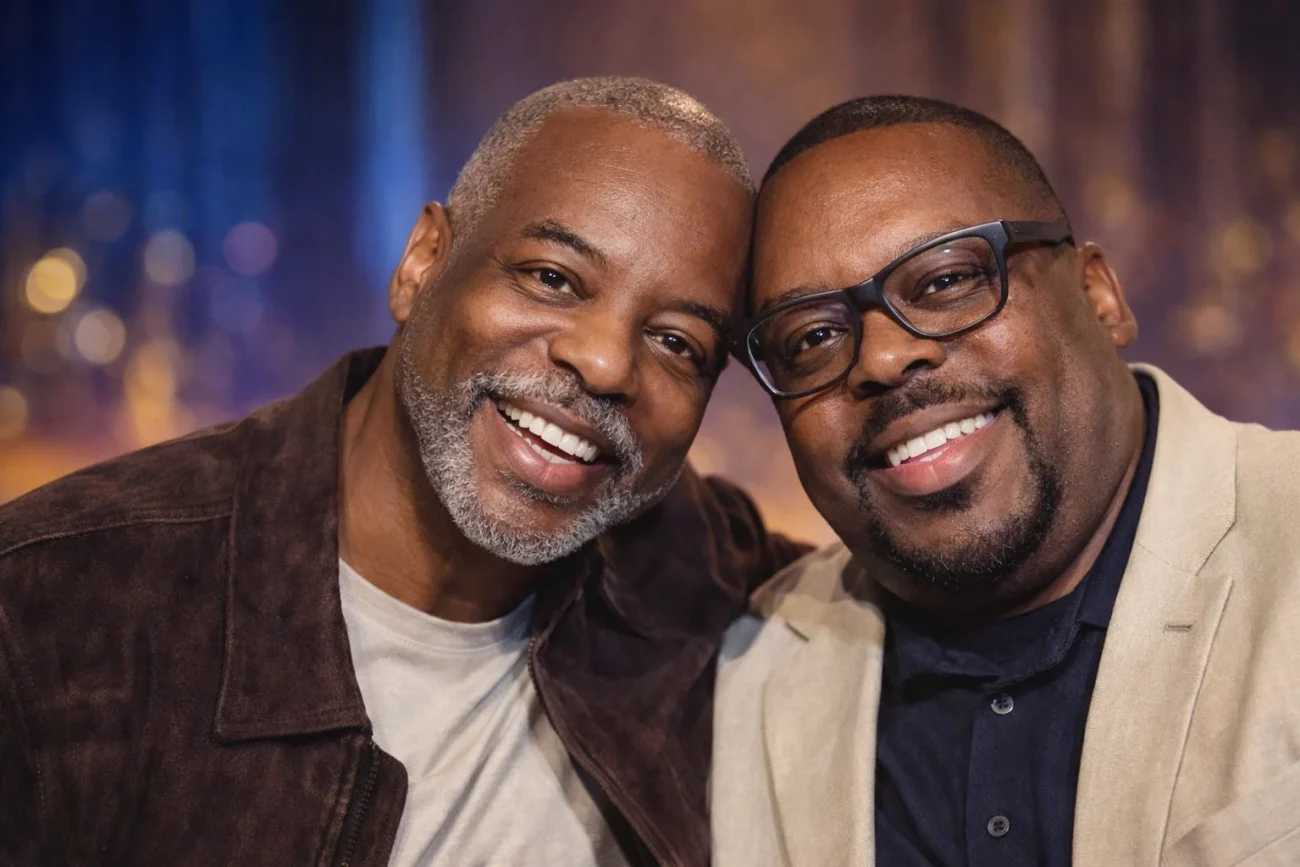
That tension still defines how he exists in the public imagination today. Unlike many children of famous parents, Eian Burton has not built a career in entertainment or public life. He has not courted media attention, maintained a visible online presence, or turned his family name into a personal brand. Yet his name continues to circulate online, driven by curiosity about his father, LeVar Burton, whose own career spans decades and cultural milestones.
To understand Eian Burton is to understand both what is known and what remains deliberately out of reach. His story is not one of celebrity in the traditional sense. It is a story about proximity to fame, the limits of public record, and the ways the internet fills in gaps when a person chooses not to.
Early Life and Family Background
Eian Burton was born around 1980 in the United States, though his exact date and place of birth have not been publicly confirmed in reliable records. His father, LeVar Burton, had already begun establishing himself as a rising actor by that time, having gained recognition for his role as Kunta Kinte in the landmark 1977 miniseries Roots. That performance would shape Burton’s career and public identity for decades to come.
His mother is identified in archival reporting as Chimara P. Smith. Unlike LeVar Burton, she has not been a public figure, and very little verifiable information exists about her life outside the context of early legal reporting involving Eian. The limited nature of that record is important, because much of what is written about Eian Burton today traces back, directly or indirectly, to a handful of news reports from the mid-1980s.
Those reports reveal that Eian’s early childhood unfolded against the backdrop of a paternity and custody dispute. In February 1984, United Press International reported that LeVar Burton had paid $8,863 in overdue child support connected to his son. A few months later, another report described a custody disagreement in which Smith alleged that Burton had not returned the child after a visit, while Burton’s representatives said the child was safe and that no custody violation had occurred.
These accounts are among the most concrete pieces of evidence about Eian Burton’s early life. They do not tell a complete personal story, but they do anchor his existence in verifiable public record. More importantly, they highlight a key truth: Eian Burton’s first appearance in the media was not by choice, but as part of a conflict between adults whose lives intersected with the public eye.
Growing Up in the Shadow of Fame
LeVar Burton’s career continued to expand throughout the 1980s and 1990s, moving from Roots into Star Trek: The Next Generation, where he played Geordi La Forge, and later into his long-running role as host of Reading Rainbow. These roles made him not just a recognizable actor, but a cultural figure associated with education, literacy, and representation.
For a child like Eian Burton, growing up alongside that kind of public recognition would have meant navigating a complicated dynamic. On one hand, his father’s work carried a strong sense of purpose and visibility. On the other, Eian himself did not step into that same public-facing world.
What’s striking is how little documented information exists about his upbringing beyond those early legal references. There are no widely reported interviews, school profiles, or public appearances that chart his childhood in the way that often happens with celebrity families. This absence is not accidental. It reflects a life that, for the most part, remained outside the media’s ongoing attention.
Not many people know this, but even within families connected to high-profile careers, privacy can be fiercely maintained. In Eian Burton’s case, that privacy appears to have held, even as his father became a familiar figure on television screens across generations.
Relationship with LeVar Burton
While early reporting emphasized legal conflict, later references suggest a more settled family relationship. In a 2023 interview with Fatherly, LeVar Burton spoke about his children and referred to Eian directly, grouping him within a family that values education. Burton described teaching and learning as part of what he called the family’s shared purpose, placing Eian within that framework.
That mention may seem small, but it carries weight. It confirms that Eian Burton is not simply a distant or forgotten figure in his father’s life. Instead, he is acknowledged as part of the family, even if the details of that relationship remain private.
The interview also provides a useful point of context. Burton noted that Eian was 14 years old when his daughter Mica Burton was born in 1994, which aligns with the commonly cited early-1980s birth year. Mica Burton herself has become a public figure, working as an actress and host, which creates a contrast between siblings who have taken very different paths in terms of visibility.
That contrast highlights an important dynamic. In some families, fame becomes a shared trajectory. In others, it becomes something that different members engage with—or step away from—in their own ways. Eian Burton appears to fall into the latter category.
Education and Career: What Can Be Verified
This is where the story becomes more complicated. A large number of online profiles describe Eian Burton as a special education teacher and, in some cases, a basketball coach working in California. These claims are repeated frequently across websites, often with similar phrasing and timelines.
The truth is, those details are not strongly supported by independently verifiable primary sources. They may be accurate, but the available public evidence does not confirm them with the level of certainty expected in reliable reporting. The repetition of a claim across multiple sites does not, on its own, make it factual.
That said, there is a reason those descriptions resonate. They align with the broader values associated with LeVar Burton’s public image, particularly his long-standing advocacy for education and literacy. It is easy to see how a narrative of Eian working in education would take hold and spread.
But here’s the thing: responsible biography depends on clear boundaries between what is known and what is assumed. In Eian Burton’s case, the safest and most accurate position is to acknowledge that his professional life has not been publicly documented in detail by mainstream sources. Anything beyond that remains, at best, unconfirmed.
Life Away from the Public Eye
One of the most defining aspects of Eian Burton’s life is how little of it has been publicly shared. In an era when many people connected to celebrities maintain social media profiles, appear in interviews, or pursue public careers, his absence is striking.
There are no widely recognized public accounts under his name, no confirmed media appearances, and no clear record of professional branding or public-facing work. This absence suggests a deliberate choice, rather than an accident of circumstance.
The truth is, staying private in a culture that rewards visibility requires intention. It means turning down opportunities that might bring attention, resisting the pull of public curiosity, and maintaining boundaries that are often difficult to enforce. For someone with a well-known parent, those boundaries can be even harder to sustain.
Yet Eian Burton appears to have done exactly that. His life, as far as the public can see, has unfolded largely outside the mechanisms that typically turn a person into a recognizable figure.
Public Image and Online Misinformation
Despite his private life, Eian Burton has developed a kind of digital presence shaped almost entirely by others. Search engines return dozens of biography pages that attempt to fill in details about his career, relationships, and personal life.
Many of these pages follow a familiar pattern. They present polished narratives that include estimated net worth figures, career summaries, and personal milestones, often without citing strong sources. Over time, these narratives begin to reinforce one another, creating the impression of consensus.
What’s surprising is how quickly this process can blur the line between fact and assumption. A detail that appears on one site can be repeated across many others, gaining credibility simply through repetition. For readers, distinguishing between verified information and recycled claims becomes increasingly difficult.
Eian Burton’s case is a reminder of how modern information systems work. When demand for a story exists, content will often expand to meet it, even if the underlying facts are limited. That does not mean all such content is wrong, but it does mean it should be read with care.
Family Context and Cultural Significance
To understand why Eian Burton continues to attract attention, it helps to look at the broader context of his father’s legacy. LeVar Burton’s work, particularly through Reading Rainbow, has had a lasting cultural impact, shaping how generations of children engage with books and learning.
That legacy carries a certain expectation. People are naturally curious about the families of figures who have played such visible roles in public life. They look for continuity, for signs that the values associated with a public figure extend into their private world.
In that sense, Eian Burton represents a different kind of story. He is part of that family history, but not in a way that is publicly documented or easily summarized. His presence is felt more through reference than through direct visibility.
This creates a kind of quiet significance. He matters not because of a public career, but because of his place within a narrative that many people recognize. That may not satisfy every reader’s curiosity, but it is a more honest reflection of what can be known.
Where Eian Burton Is Now
As of 2026, there is no widely verified, up-to-date public record detailing Eian Burton’s current activities, location, or professional role. That lack of information is consistent with the broader pattern of his life: a deliberate distance from public exposure.
What can be said is that he remains part of LeVar Burton’s acknowledged family. Beyond that, any attempt to describe his current life in detail would move beyond confirmed information and into speculation.
There’s a quiet clarity in that. Not every life connected to fame becomes a public narrative, and not every name that appears in search results comes with a fully documented story. Eian Burton’s current status reflects that reality.
Frequently Asked Questions
Who is Eian Burton?
Eian Burton is the son of actor and television host LeVar Burton. He first appeared in public records as a child in the 1980s due to a legal dispute involving his parents. Beyond that, he has remained largely private and is not a public figure in the traditional sense.
How old is Eian Burton?
Based on archival reporting that described him as a young child in 1984, he is believed to have been born around 1980. This would make him approximately 45 years old as of 2026, though his exact birth date has not been publicly confirmed.
What does Eian Burton do for a living?
There are widespread claims that he works as a special education teacher or coach, but these details are not strongly supported by reliable primary sources. His professional life has not been publicly documented in a verifiable way.
Who are Eian Burton’s parents?
His father is LeVar Burton, known for roles in Roots and Star Trek: The Next Generation, as well as hosting Reading Rainbow. His mother is Chimara P. Smith, who is not a public figure.
Is Eian Burton married?
There is no publicly confirmed information about his marital status or relationships. Many online sources make claims about his personal life, but these are not backed by strong evidence.
Why is Eian Burton famous?
He is not famous for a public career. His name is known primarily because of his connection to LeVar Burton and the curiosity that surrounds the families of well-known figures.
Conclusion
Eian Burton’s story is, in many ways, defined by what is not known. While his name appears in search results and biography pages, the verified public record is limited to a few key facts about his family and early life. Everything else sits in a space between possibility and assumption.
That absence is not a flaw in the story. It is part of what makes it meaningful. In a culture that often equates visibility with importance, Eian Burton represents a different path, one where a person connected to fame can still choose privacy.
His life reminds us that not every story needs to be fully documented to be real. Sometimes, the most accurate account is the one that respects the limits of what can be known.
And for readers, that may be the most useful takeaway. Curiosity is natural, but so is restraint. Eian Burton’s biography, as it stands, is less about filling in every detail and more about understanding the boundaries between public record and personal life.
