
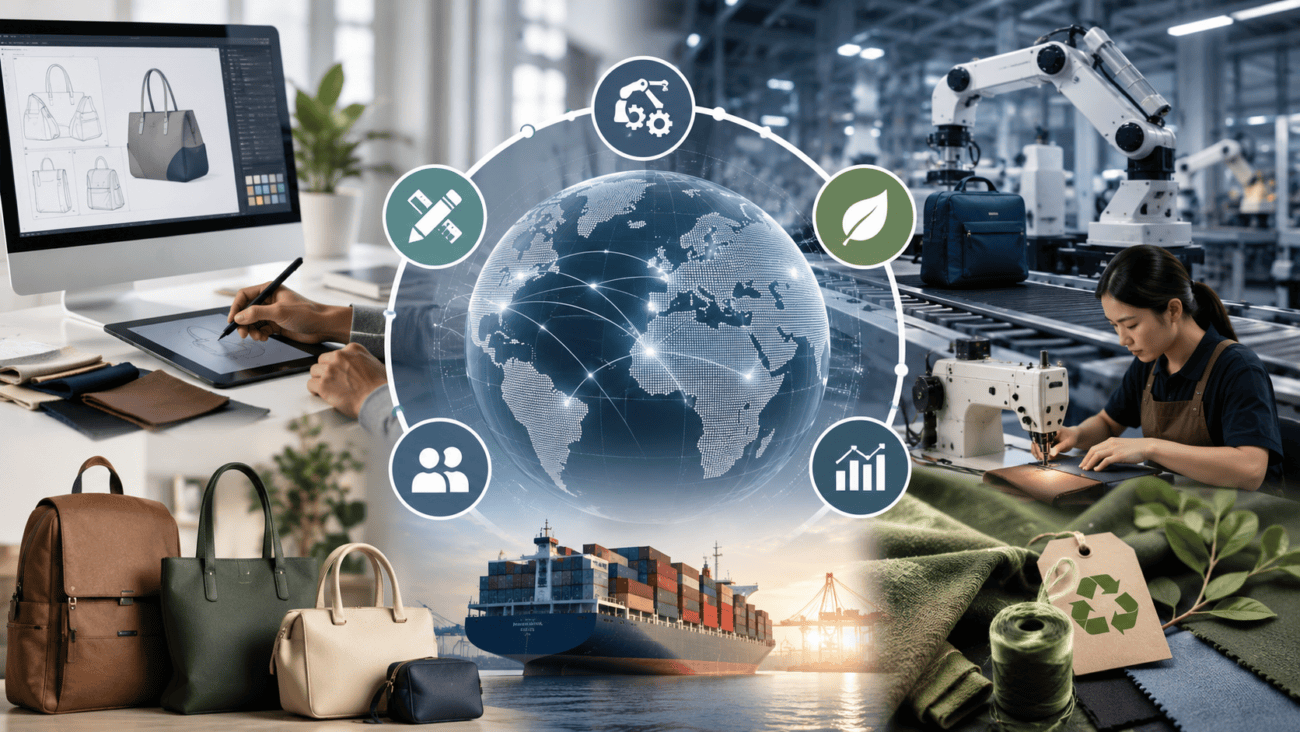
The global bag manufacturing industry is entering a period of significant transformation. For decades, competition in the sector was mainly driven by production capacity, manufacturing costs, and large-scale orders. However, the industry is now being reshaped by stricter environmental requirements, technological innovation, supply chain restructuring, and changing sourcing strategies.
According to industry data, the global luggage and bags market reached approximately $170.2 billion in 2025 and is expected to grow to around $220 billion by 2030. While the market continues to expand, the competitive landscape is becoming increasingly challenging. Recent years have seen pressure on export prices, rising compliance requirements, and greater demand for flexible and transparent supply chains.
As a result, bag manufacturers are moving beyond traditional cost-based competition. Product development capabilities, manufacturing flexibility, quality management systems, and supply chain efficiency are becoming increasingly important factors for global buyers when selecting suppliers.
This article explores five key trends that are reshaping the future of global bag manufacturing.
1. Sustainability Becomes a Core Requirement for Bag Manufacturing
Sustainability is becoming one of the most important factors influencing the future of the global bag industry.
Previously, environmental considerations were often viewed as an additional requirement rather than a fundamental business priority. Today, however, brands and international buyers are placing greater emphasis on sustainable materials, responsible production processes, and compliance with environmental standards.
Many bag manufacturers are exploring alternatives to traditional materials, including recycled polyester, recycled nylon, bio-based materials, and environmentally friendly coatings. These materials allow companies to reduce their environmental impact while meeting the growing demand from consumers for more sustainable products.
In addition to materials, manufacturing processes are also changing. Energy-efficient production equipment, waste reduction programs, improved material utilization, and responsible chemical management are becoming increasingly important parts of modern bag production.
For global buyers, sustainability is no longer simply about marketing value. It has become closely connected with supply chain management, regulatory compliance, and long-term brand reputation.
Manufacturers that can provide sustainability certifications, transparent production processes, and environmentally responsible solutions will have stronger advantages when competing for international orders.
2. Smart Technology Opens New Growth Opportunities
Smart technology is becoming an emerging growth driver in the luggage industry, enabling manufacturers to develop products with integrated digital functions and enhanced user experiences, especially in the travel sector.
According to industry research, the global smart luggage market was valued at approximately $2.1 billion in 2025 and is projected to reach around $7.3 billion by 2030. This growth reflects increasing demand for connected travel solutions, including GPS tracking systems, smart locks, USB charging functions, and other digital features.
For bag manufacturers, the rise of smart luggage represents a shift from traditional manufacturing toward more integrated product development. Companies need to strengthen cooperation with technology suppliers, improve product engineering capabilities, and develop production processes that combine soft goods manufacturing with electronic components.
Although smart luggage currently represents a relatively small segment of the overall luggage market, its rapid growth highlights a broader trend: future bag products will increasingly combine functionality, technology, and user-oriented design.
3. Specialized Bags Drive Market Segmentation
Another major trend reshaping the bag manufacturing industry is the rapid growth of specialized product categories.
In the past, many manufacturers focused primarily on general-purpose products such as basic backpacks, handbags, and travel bags. Today, market demand is becoming increasingly segmented as consumers seek products designed for specific lifestyles and applications.
Examples include:
- Laptop backpacks designed for business professionals
- Outdoor bags developed for hiking and adventure activities
- Camera bags designed for photographers
- Tactical backpacks for professional and outdoor users
- Medical bags and equipment carriers
- Sustainable bags targeting environmentally conscious consumers
This shift reflects changing consumer behavior. Different user groups now expect products that provide targeted solutions rather than simply fulfilling basic carrying functions.
For international buyers and brands, specialized product categories also provide opportunities for stronger market positioning. Instead of competing only on price, companies can differentiate themselves through product design, functionality, and customer experience.
As a result, bag manufacturers with strong OEM and ODM capabilities are becoming increasingly valuable partners. They can support brands in developing customized products that match specific market needs.
4. Supply Chains Move Toward Greater Transparency and Regional Diversification
Global bag supply chains are undergoing significant restructuring as brands and buyers seek greater stability, transparency, and risk management.
For many years, international bag sourcing relied heavily on traditional production models concentrated in a limited number of manufacturing regions. However, recent changes in trade policies, labor costs, logistics conditions, and geopolitical factors have encouraged companies to diversify their sourcing strategies.
Many global buyers are now exploring multi-country manufacturing networks to balance cost efficiency, production capacity, and supply chain security. Different manufacturing regions are developing their own advantages based on factors such as infrastructure, workforce availability, production experience, and market access.
At the same time, direct cooperation between brands and bag manufacturers is becoming increasingly common. By working more closely with production partners, buyers can gain better visibility into manufacturing processes, quality control standards, and delivery schedules.
In this evolving environment, manufacturers with strong production capabilities, compliance systems, and transparent supply chain management will be better positioned to support global sourcing needs.
5. Flexible Production Models Become Essential
The traditional bag manufacturing model was mainly built around large-volume production. However, market demand is becoming increasingly unpredictable, making flexibility a critical competitive advantage.
Brands today are launching more product variations, testing smaller market segments, and responding faster to consumer trends. As a result, many buyers are seeking suppliers that can support smaller batch production, faster sampling, and customized development.
This trend is particularly important for emerging brands and e-commerce companies, which often need to test products before committing to large-scale orders.
Modern bag manufacturers are responding by improving their product development systems, digital design capabilities, and production management processes. Faster sample development, efficient communication, and flexible manufacturing arrangements are becoming key factors when buyers select suppliers.
OEM and ODM services are also playing a more important role. OEM allows brands to create products based on their own specifications, while ODM enables them to utilize existing design expertise and manufacturing resources to accelerate product development.
In the future, successful manufacturers will not only be production providers but also solution partners that help brands bring products to market more efficiently.
Conclusion: The Future Belongs to Adaptable Manufacturers
The global bag manufacturing industry is moving into a new stage of development. While cost competitiveness remains important, it is no longer the only factor determining success.
Sustainability, smart technology, specialized products, supply chain transparency, and flexible production models are becoming the major forces shaping the industry’s future.
For international buyers, choosing the right manufacturing partner will increasingly depend on more than price. Production capability, innovation, quality management, compliance standards, and supply chain flexibility will all play essential roles.
Manufacturers that can adapt to changing market demands and provide comprehensive solutions will have stronger opportunities in the global market.
As the industry continues to evolve, the future of bag manufacturing will belong to companies that combine manufacturing expertise with innovation, responsibility, and the ability to respond quickly to global market changes.
