
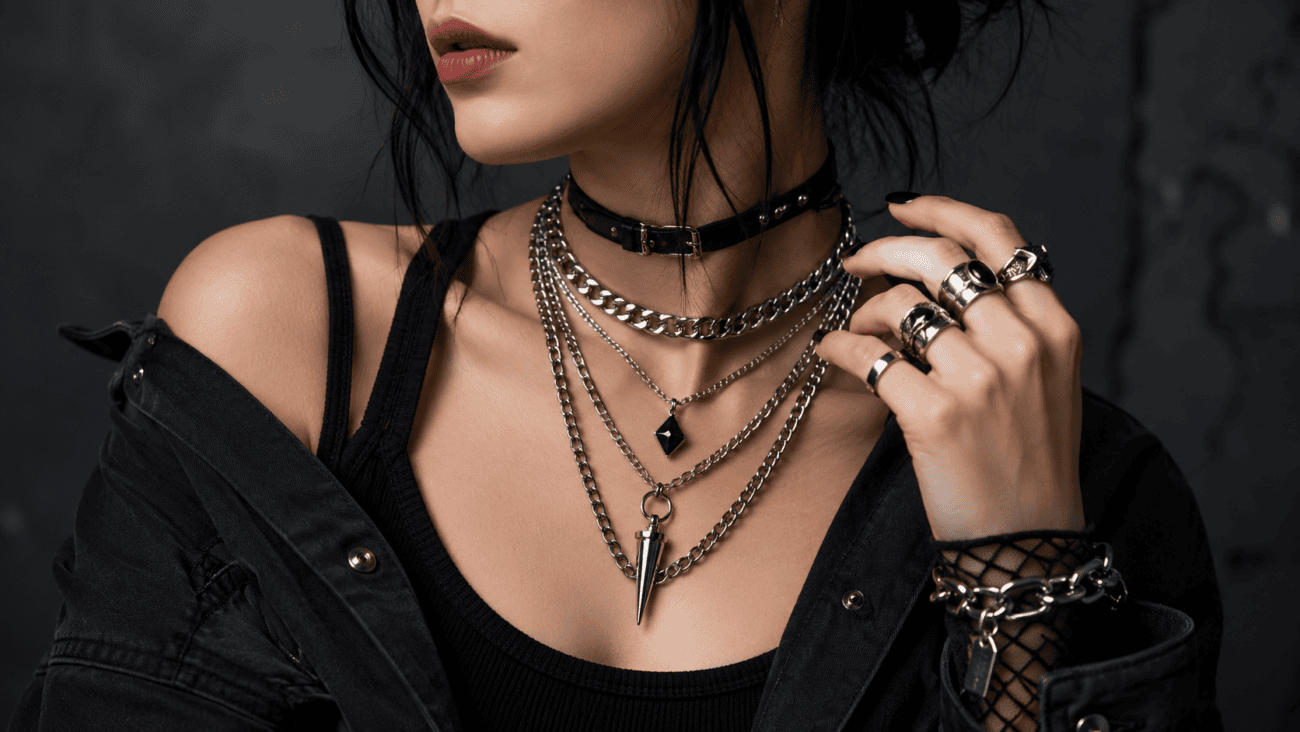
Jewellery is the cheapest way to change an outfit and the easiest way to ruin one. A single well-placed chain can carry a plain black dress; five competing chains turn the same dress into visual noise. The difference is not taste — it is a handful of rules about length, weight and finish that are easy to learn and rarely written down.
Rule One: Vary the Lengths, Not Just the Count
The most common layering mistake is wearing three necklaces of almost the same length. They tangle, they overlap, and the eye cannot separate them.
Work with clear intervals of at least 5–7 cm. A reliable three-piece stack looks like this:
- Choker — 35–40 cm, sitting against the throat.
- Short chain — 45–50 cm, at the collarbone.
- Pendant — 60–70 cm, mid-chest, carrying the focal piece.
Only one of the three should be a statement. The other two are structure. If two pieces both have large pendants, they will fight, and neither wins.
Rule Two: Vary the Weight
Three fine chains read as delicate. Three heavy chains read as armour. A mix of one heavy and two fine reads as deliberate styling, which is usually what you want.
The most reliable combination in alternative jewellery is a wide, chunky choker or collar with fine chains hanging below it. The visual weight sits high, close to the face, and everything below stays light.
Rule Three: Pick a Metal and Stay With It
Silver-tone, antique silver, black-plated, gold-tone and antique brass all sit in different families. Mixing them is possible but hard — it needs a piece that contains both finishes to bridge them.
The simplest approach: choose one finish for a given outfit and extend it to your rings, earrings, belt buckle, bag hardware and boot eyelets. Consistent hardware across an outfit is one of the strongest signals of intentional dressing, and almost nobody does it.
For gothic and punk styles, blackened or antiqued silver is the most versatile default. It sits well against black clothing without disappearing into it, and it hides wear better than bright plating.
Chokers: The Highest-Impact Item Per Pound
Nothing changes the character of an outfit as quickly as a choker. The variants each say something different:
- Velvet ribbon — romantic, Victorian, soft.
- Leather with O-ring or D-ring — punk, harder edge.
- Wide collar with studs or spikes — aggressive, deathrock.
- Lace — romantic goth, pairs well with high necklines.
- Chain choker — modern and neutral; works with almost anything.
Fit matters more than people expect. A choker should sit snugly enough not to slide but leave a full finger’s width of room. Too loose and it reads as a fallen necklace; too tight and it is genuinely uncomfortable for a long evening. Look for an extension chain of at least 5 cm.
Rings: Build a Hand, Not a Collection
Rings are where alternative jewellery gets genuinely fun, because the risk of overdoing it is low and the cost is small.
A workable structure: one large statement ring, two medium rings, and one or two thin bands, distributed across both hands. Put the statement ring on the index or middle finger, where it is most visible. Avoid loading one hand entirely — balance across both looks more natural in photographs and in person.
Practical points: base-metal rings will tarnish and can mark skin, which a coat of clear nail varnish on the inner band prevents. Stainless steel and sterling silver both hold up far better for daily wear. Measure your finger in the evening, when it is largest, and remember that wide bands need a half size up compared with thin ones.
Earrings, Cuffs and the Balance Question
If you are wearing a heavy neck stack, keep earrings small — studs or short drops. If your neckline is bare or high-collared, that is when long, dramatic earrings have room to work.
The same balance rule applies to wrists. A stacked cuff, bangles and bracelets on one arm with the other left bare looks composed. Both arms loaded looks like inventory.
For sourcing, specialist alternative retailers carry a far wider range of lengths and finishes than mainstream jewellery shops — the gothic jewellery selection covers chokers, layered chains, rings and pendants in matching finishes, which makes building a consistent set considerably easier than assembling one piece at a time from different sources.
Match the Jewellery to the Neckline
This is the detail that separates good styling from guesswork:
- High neck or turtleneck — long pendants over the top, or nothing at all. No chokers.
- Deep V — a pendant that ends above the point of the V, plus a choker.
- Scoop or round neck — layered short chains that echo the curve.
- Off-shoulder — a choker or collar, and statement earrings. Skip long chains.
- Corset or strapless — a choker plus one mid-length chain; the exposed collarbone does most of the work.
Care Takes Two Minutes
Store chains flat or hanging, never tangled in a box. Take jewellery off before showering, swimming and sleeping — water and body oils are what dull plating. Wipe pieces with a dry cloth after wearing, and keep silver in a small sealed bag with an anti-tarnish strip.
Leather and velvet chokers should never go in water. Wipe leather with a barely damp cloth, brush velvet with a soft brush, and let both dry flat away from heat.
Done consistently, this keeps inexpensive jewellery looking good for years — which matters, because in this category the difference between striking and cheap is almost entirely about condition.
